Why measure?
Why measure NAD?
NAD is a bioactive form of vitamin B3 and an essential coenzyme and substrate in more than 500 metabolic reactions. One of the best-known functions of NAD is its role in mitochondrial energy production. The body continuously synthesizes NAD from dietary vitamin B3 to maintain levels sufficient for metabolic needs.
Under certain conditions, however, NAD demand may exceed supply, leading to metabolic dysfunction. This makes NAD a potentially valuable biomarker for assessing metabolic and mitochondrial health.
Combining NAD readouts with other biomarkers and health data enhances the diagnostic value of NAD measurement. In certain contexts, NAD can also serve as a standalone biomarker, for example when monitoring treatment effects or drug-related side effects.
While the full potential of NAD and glutathione is still emerging, the rapid growth of metabolism-focused research suggests that significant breakthroughs across multiple disease areas are likely in the near future.
Below are just a few examples of how different user groups can benefit from measuring NAD.
Why measure NAD in a nutshell

Low NAD levels compromise energy production, repair capacity, and metabolic resilience.
Excessively elevated NAD levels are associated with metabolic disorders and vascular inflammation.
The NAD⁺/NADH ratio is a defining factor in redox status of the cell, mitochondrial efficiency, and metabolic flexibility.
Altered NAD metabolism has been linked to metabolic, neurodegenerative, cardiovascular, and inflammatory disease states.
NAD measurement enables patient stratification, supporting drug development and precision health strategies.
As a systemic biomarker, NAD offers deeper diagnostic insight interpreted alongside clinical history and complementary markers.
Supplementation strategies benefit from monitoring to optimize dosing and track biological response.
Practitioners
Metabolism is central to health and disease. One way to assess it in clinical practice is to measure key metabolites that regulate metabolic processes. Many conditions are driven by underlying metabolic dysfunction that may remain undetected by standard diagnostics.
NAD measurement provides direct insight into cellular energy production and redox balance, offering a more functional view of patient health beyond symptoms alone.
By integrating NAD into patient work, it becomes possible to:
- detect early metabolic imbalance
- detect vitamin B3 deficiency
- support personalized treatment and precision medicine approach
- help monitor oxidative stress and disease-related metabolic changes
NAD measurement brings metabolic insight into everyday clinical decision-making.
Researchers
Redox metabolites have traditionally been measured using mass spectrometry (MS). While effective in many contexts, MS has limitations in redox analysis, particularly due to the instability of reduced forms under applied analysis conditions, resulting in level estimation rather than quantification.
In addition, most approaches capture only part of the redox system, limiting the ability to interpret metabolic state comprehensively.
Direct measurement of the full redox panel – including NAD⁺, NADH, NADP⁺, NADPH, and glutathione – provides a more accurate and functional view of cellular metabolism.
This enables:
- Comprehensive redox profiling: Measure NAD⁺, NADH, NADP⁺, NADPH and glutathione to capture the full redox system
- True redox insight: Quantify oxidized and reduced forms individually to assess NAD⁺/NADH balance
- Translational relevance: Bridge in vitro findings to in vivo tissue and whole-blood studies
- Scalable workflows: Microplate-based format supports medium- to high-throughput studies
- Cost-efficient and practical: Reproducible measurements using standard laboratory equipment without MS complexity
Capturing the full redox landscape enables deeper insight into mitochondrial function, oxidative stress, and metabolic regulation.
Pharma & CROs
Drug development remains a high-risk process, with nearly 90% of candidates failing before reaching the market. Early-stage trials often reveal issues such as toxicity, poor pharmacokinetics, or lack of efficacy—resulting in significant time and financial losses.
One of the key limitations is the lack of functional biomarkers that reflect real-time metabolic responses to therapeutic interventions.
Integrating redox metabolite profiling into preclinical and clinical studies provides a dynamic view of drug response and mechanism of action.
This enables:
- Mechanistic insight (PK/PD): Track how drug candidates affect NAD⁺, NADH, NADP⁺, NADPH and glutathione-linked pathways
- Early risk detection: Identify toxicity and metabolic liabilities before costly late-stage failures
- Target engagement: Monitor whether interventions impact intended metabolic pathways
- Patient stratification: Distinguish responders vs. non-responders and define meaningful subgroups
- Translational consistency: Harmonised measurement across preclinical models and clinical cohorts
By capturing functional metabolic changes, redox profiling supports more informed decision-making and increases the probability of success in drug development.
Consumers
NADs are often mistakenly viewed as just another supplement, but they are, in fact, very potent molecules with profound effects on the body. Their impact on health extends far beyond what is commonly understood, influencing everything from metabolism to cellular repair and signaling. Low NAD concentrations can contribute to persistent fatigue and may reveal underlying metabolic or mitochondrial dysfunctions. Being aware of NAD deficiencies can help identify potential health issues early and guide effective interventions.
NAD supplementation is more than just a boost; it can play a crucial role in disorders characterized by significant energy loss, while also optimizing overall health. However, excessive supplementation without proper monitoring can disrupt metabolic balance and may have harmful effects, underlining the importance of accurate measurement and tailored dosing.
Imbalanced NAD levels have been linked to a wide range of health conditions, including:
Metabolic diseases
Mitochondrial diseases
Cancer
Neurodegenerative diseases
(e.g., Alzheimer’s and Parkinson’s)
Inflammatory conditions (e.g., Long COVID)
Kidney injury
Cardiovascular diseases
Biological aging
Neuromuscular conditions
Ocular neurodegeneration of glaucoma
The NAD+/NADH ratio
Measuring NAD+ alone doesn’t give the full picture of NAD+-dependent metabolism. It’s the balance between NAD+ and NADH, known as the redox ratio, that reveals how efficiently energy carried by NADH is used by the cells.
A high NAD+/NADH ratio typically signals healthy energy transduction from one form to the other, while an imbalance may be a sign of a metabolic or mitochondrial disorder. NADMED is the only company on the market offering a reliable, easy-to-use solution for measuring both NAD+ and NADH.
Why measure glutathione?
Glutathione is needed for the maintenance of redox homeostasis, for protecting cells from oxidative damage, for regeneration of other antioxidants, and for detoxification of endogenous and exogenous compounds. It also contributes to immune and metabolic regulation.
Elevated oxidative stress or insufficient glutathione levels can lead to a variety of health issues, such as chronic inflammation, cardiovascular diseases, and certain cancers. Measuring glutathione reveals how efficiently the body neutralizes oxidative stress and shields its cells from damage. Reduced glutathione is also an actionable target, as one can modulate levels by taking precursors.
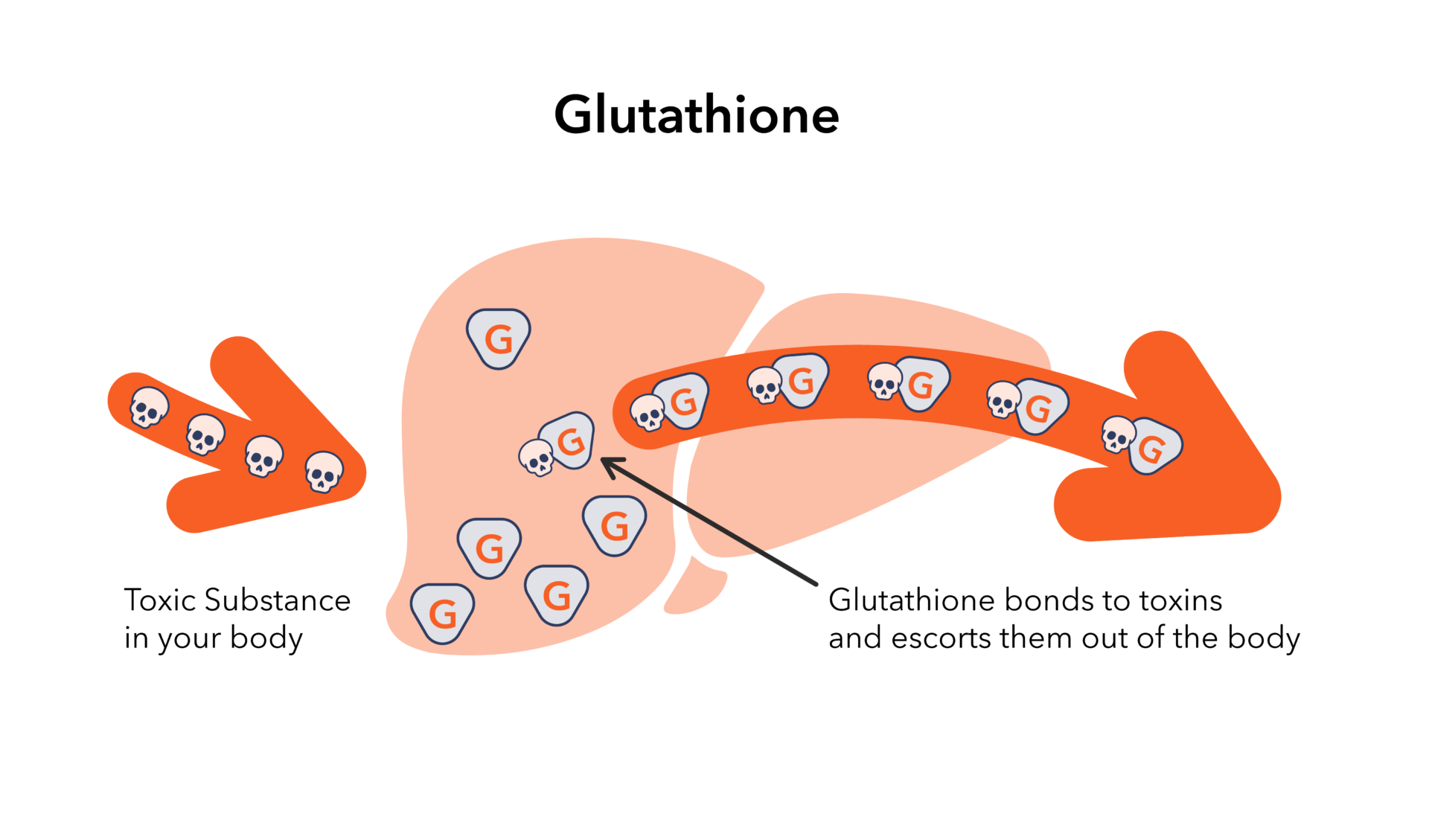
Example of detoxification property of Glutathione in liver
Glutathione assists in the excretion of xenobiotics from the body. The process takes place in the liver, where glutathione is conjugated with harmful compounds, making them more water-soluble and enabling their excretion in bile and urine.
Why measure both NADs and glutathione?
NAD+ levels indicate vitamin B3 status and serve as a biomarker for B3 deficiency, while NADP+, NADPH, and glutathione levels reflect resilience of the body to different stress factors. Both NADs and glutathione are actionable targets that can be modulated by lifestyle, diet, and supplementation.
Measuring both NADs and glutathione offers a detailed view of cellular function, assessing not only energy production but also the body’s capacity to combat oxidative damage.
Yes, I want to receive the NADMED Test Interpretation Guide for Practitioners.